



Demystifying AI: Core Concepts for Salesforce Professionals
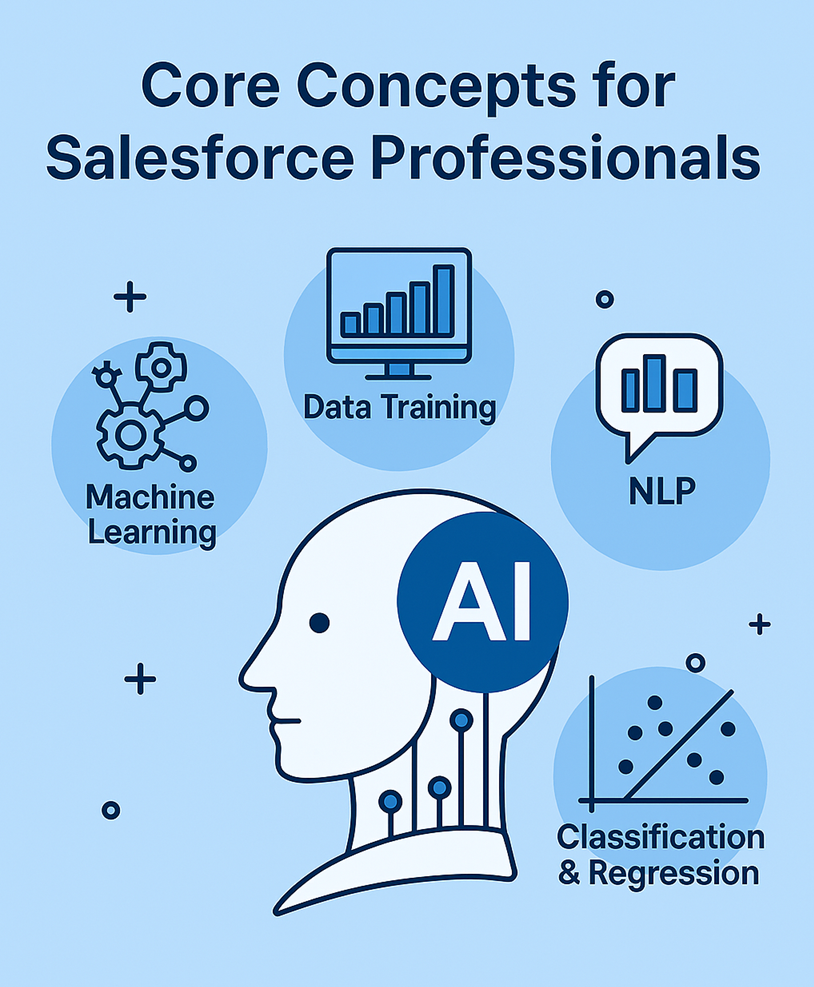
You’ve probably heard the buzz-Artificial Intelligence (AI) is transforming industries, and the Salesforce world is no exception. From Einstein to the latest advancements in generative AI, it’s an exciting time. While it can feel a bit overwhelming, let’s be real-understanding AI doesn’t have to be like trying to decipher ancient hieroglyphs.
Fasten your seatbelts. In this article, we will cut through the hype, ditch the confusion, and master the core AI concepts that are reshaping Salesforce. This blog post is your friendly guide to demystifying AI. By the end, you’ll have a solid foundation to confidently navigate the world of AI in Salesforce and understand how it’s used in features like AgentForce, Einstein, and beyond. We’ll make it fun, informative, and (dare we say) even a little bit cool.
Why Should Salesforce Professionals Care About AI?

Let’s face it-Salesforce isn’t what it was five years ago. It’s smarter, faster, and, dare we say, a little magical. With the rise of Einstein AI, AgentForce, and built-in generative AI tools, you’re no longer just managing records-you are unlocking a smarter way of working. You are not just clicking around dashboards anymore-you’re partnering with intelligent systems that learn as you work.
So, why should you care?
Because in today’s world, AI gives you an unfair advantage:
- It automates the boring stuff, so you can skip the grunt work and focus on what matters.
- It helps you deliver magical customer experiences-the kind that makes users say “wow.”
- It lets you make smarter, faster decisions without staring at spreadsheets for hours.
But that’s not all.
Understanding AI also helps you:
- Leverage it effectively: Know exactly how AI features work and how to make them work for you.
- Stay ahead of the curve: New AI tools drop often-get ready to adapt and impress.
- Speak AI confidently: Whether in meetings, client calls, or strategy sessions.
- Maximize AgentForce: Understand the “brains” behind the bot, and how to fine-tune it to scale excellent service.
Artificial intelligence (AI) isn’t just a buzzword-it’s your new secret weapon. Learning AI is no longer optional-it’s essential. Just a little curiosity, a splash of Trailhead, and a solid cup of coffee-and boom-you’re in the AI game.
What is Artificial Intelligence: The Salesforce Way
Artificial Intelligence, at its core, is about making machines smart-teaching them to learn, reason, and make decisions the way humans do. In Salesforce, AI isn’t just a technical layer-it’s your digital co-pilot that’s deeply woven into the platform you already use.
Instead of forcing you to learn some mysterious new tech stack, Salesforce wraps AI right into your day-to-day tools. That’s what makes the Salesforce approach to AI so unique-it’s designed for you, not just for data scientists in lab coats.
Here’s how AI shows up across the platform:
- Einstein Lead Scoring – Helps you focus on leads that are likely to convert.
- Einstein Case Classification – Sorts cases before you even open them.
- Einstein Bots – Your ever-ready chat sidekicks.
- AgentForce AI Agents – Fully autonomous support heroes that learn and improve with every interaction.
With Salesforce, AI isn’t a separate experience. It’s baked right in, accessible, powerful, and designed to help you work smarter, not harder.
Core AI Concepts Every Salesforce Professional Should Know
Think of AI as your super-smart intern-one who never sleeps, learns fast, and doesn’t complain about Zoom fatigue. To make sure you speak the same language, let’s break down the key AI concepts that are most relevant to Salesforce professionals:
Machine Learning (ML): The Learning Engine
Ever wonder how computers learn to get better at stuff without being explicitly told how? That’s Machine Learning! Think of it as teaching a computer to learn from experience, just like we do! Instead of explicitly programming every step, we provide the computer with data, and it learns to identify patterns and make predictions
In a Nutshell: Algorithms that enable computers to learn from data without being explicitly programmed.
Machine Learning in Action: Einstein uses ML for features like predictive lead scoring, which helps sales teams prioritize the hottest leads, and opportunity insights, which forecast the likelihood of closing a deal.
Einstein can analyze past deal outcomes, customer interactions, and market trends to predict which opportunities are most likely to close, allowing sales reps to focus their energy on the most promising deals.
It’s like having a super- Sales Assistant who whispers, “Hey, focus on this customer, they’re ready to buy that yacht!”
Data Training: Feeding the AI Brain
Before AI can work its magic, it needs to learn from examples, just like us! This process is called “data training,” where we feed historical data to the AI so it can identify patterns and relationships. Think of it as showing a student a bunch of flashcards to help them learn a new subject. The better the flashcards (data), the smarter the student (AI) becomes.
In a Nutshell: Feeding historical data to AI so it can learn.
Data Training in Action: In Salesforce, this is crucial for features like Einstein Prediction Builder. Imagine you want Einstein to predict which leads are most likely to convert. You’d “train” it by providing data on past leads, including details like their source, industry, and interactions, and whether they ultimately converted or not. The more data you provide, the more accurate Einstein’s predictions will be, helping your sales team focus on the hottest prospects.
Supervised Learning aka Guided Training: Learning with a Teacher
This is a type of machine learning where the AI learns from “labeled” data, which means the data includes the “right answers.” It’s like learning with a teacher who provides feedback and guides you to the correct solution.
In a Nutshell: Learning from labeled data.
Supervised Learning in Action: In Salesforce, this is used in scenarios like predicting lead conversion. You’d feed Einstein data on past leads, labeled as “converted” or “not converted,” and Einstein learns to identify the factors that contribute to conversion, allowing it to predict the likelihood of future leads converting.
Unsupervised Learning aka Unguided Training:
In contrast to supervised learning, unsupervised learning involves the AI finding hidden patterns in “unlabeled” data, without any “right answers” provided. It’s like exploring a new city without a map, trying to find interesting places, and figuring out how everything is connected.
In a Nutshell: Finding hidden patterns in unlabeled data.
Unsupervised Learning in Action: In Salesforce, this can be used to segment customers based on their interactions with your company, allowing you to tailor your marketing and sales efforts to each group. For example, you could identify groups like “customers who always buy during sales” or “customers who are at risk of churning,” and then create targeted campaigns to maximize their value or prevent them from leaving.
Natural Language Processing (NLP): Understanding and Generating Language
Ever wish your computer could understand you as well as your best friend? That’s the goal of NLP! NLP is all about enabling computers to understand, interpret, and even generate human language in a valuable way. It’s the magic that lets computers understand your rambling emails and (sometimes) give you a helpful response.
In a Nutshell: AI’s ability to process and understand human language.
NLP in Action: Einstein Bots, which automate customer service interactions, and Service Cloud Text Analytics, which analyzes the tone of customer messages, rely on NLP. AI reads tickets and flags angry customers before they rage-quit.
Classification vs. Regression: Predicting Categories or Values
These are two fundamental types of problems that AI can solve, each with its approach and output:
Classification: This involves predicting which category something belongs to. The output is a label or a class.
Regression: This involves predicting a numerical value. The output is a number.
In a nutshell: Predicting categories or values.
Classification in Action: In Salesforce, Einstein can use classification to automatically route cases to the appropriate support team (“This is a billing issue”) or to categorize customer sentiment as “positive,” “negative,” or “neutral.”
Regression in Action: Einstein can also use regression to predict the likelihood of a deal closing and its potential value (“That deal might be worth $5K”), helping sales teams prioritize their efforts.
Deep Learning (DL): The Power of Neural Networks
Okay, things are about to get a little more mind-bending, but stick with me! Deep Learning is a specialized type of Machine Learning inspired by the human brain. It uses complex structures called neural networks with many layers to analyze very intricate data, like images, speech, and text. Think of it as ML on steroids, tackling the tough stuff.
In a Nutshell: A subfield of ML that uses multi-layered neural networks to process complex data.
Deep Learning in Action: Einstein Vision, which allows you to classify images within Salesforce, and Einstein Language, which understands the sentiment behind customer conversations, are powered by Deep Learning.
For instance, a retail company could use Einstein Vision to automatically categorize product images uploaded by customers, or a call center could use Einstein Language to analyze customer feedback and identify areas for improvement. Imagine a clothing company automatically tagging images of “summer dresses” or a support team quickly identifying “frustrated customer” comments.
Algorithms: The Recipes of AI
At the heart of every AI system are algorithms. These are the sets of rules or instructions that the AI follows to learn from data and make decisions. They’re the secret sauce, the hidden formulas that make the magic happen.
In a Nutshell: The set of rules that an AI model uses to learn and make predictions.
Salesforce Relevance: Einstein employs various algorithms to power its diverse set of features, working behind the scenes to deliver valuable insights and automation.
For instance, Einstein uses algorithms to analyze customer data and identify patterns that can help predict customer churn, allowing businesses to proactively address potential issues and improve customer retention. It’s like having a crystal ball that tells you which customers are about to jump ship, so you can win them back with some sweet deals and even sweeter apologies.
AI-Powered Actions in Salesforce:
Let’s connect the above concepts to the Salesforce ecosystem with some examples:
- Data is King (and Queen!): Just like the brain needs information, AI models in Salesforce learn from data. The more high-quality, relevant data you have in your Salesforce org, the better Einstein performs. Think of your Salesforce data as the fuel that powers the Einstein rocket ship.
- Einstein: Your Salesforce AI Powerhouse: Einstein is the AI layer within Salesforce, bringing these core concepts to life across various clouds and features. It’s the friendly AI that lives inside your Salesforce org, ready to lend a hand (or, you know, a sophisticated algorithm).
- Einstein Lead Scoring: Want to know which leads are most likely to close? Einstein Lead Scoring helps you prioritize leads, like a heat-seeking missile for your best prospects. Helps sales focus on high-potential leads.
- Einstein Opportunity Insights: Want to know if that deal is going to close? Einstein Opportunity Insights predicts deal closures, giving you the edge in closing that big sale.
- Predictive Forecasting: Want to see into the future? Predictive Forecasting lets you see into the future… of your sales numbers.
- Einstein Case Classification: Recommends fields to support agents.
- AgentForce: AI agents that resolve common issues instantly.
- Einstein Bots: Want to give your agents a break from the routine stuff? Einstein Bots chat with customers, handling those routine inquiries so your agents can focus on the truly tricky stuff. They are your 24/7 conversational superheroes.
- Service Cloud Text Analytics: Want to know the tone of those customer messages? Service Cloud Text Analytics analyzes message tone.
- Einstein Language: Want to know how your customers feel? Einstein Language analyzes customer sentiment, so you know if they’re “happy camper” or “ready to unleash the Kraken”
- Einstein Vision: Need to automatically categorize images? Einstein Vision can classify images, like automatically tagging customer photos of damaged products.
Salesforce is rapidly innovating in this space, with new features being developed to automate content creation and enhance user experiences.
The AI Development Lifecycle in Salesforce:
Salesforce simplifies the process, but in general, it follows these steps:
- Data Preparation: Gathering and cleaning the data. Think of it as tidying up your room before the AI arrives to learn.
- Model Training: Using algorithms to learn from the data. This is where Einstein goes to school.
- Deployment: Making the AI model available for use. Time to unleash Einstein into the wild!
- Monitoring: Ensuring the model continues to perform well. Like giving Einstein regular check-ups to make sure it’s in tip-top shape.
AI and AgentForce: Transforming Customer Service
So, how does all this relate to AgentForce?
The AI concepts we’ve discussed are the building blocks of an intelligent AgentForce. It’s what makes AgentForce more than just a tool, but a super-powered customer service sidekick!
- NLP empowers Einstein Bots to understand customer queries and provide instant support, freeing up agents for complex issues. They’re the first line of defense, handling the easy stuff so your human agents can swoop in for the win on the tough cases.
- Machine Learning is at the heart of Einstein Case Classification and Einstein Recommendations, helping agents resolve cases faster and more efficiently. It’s like giving your agents a super-brain that instantly knows the best way to solve a problem.
- Generative AI holds the potential to revolutionize agent workflows by automating tasks like generating case summaries and suggesting tailored responses. Imagine agents having AI that writes the first draft of their case notes or suggests the perfect response to a customer’s email!
By understanding these AI fundamentals, you’ll be well-equipped to grasp how AgentForce leverages AI to create a more efficient, effective, and customer-centric service experience. It’s not just about fancy technology; it’s about making customer service smoother, faster, and more human-like (ironically, with the help of AI!).
Conclusion: Your AI-Powered Salesforce Journey Begins Now
We’ve covered a lot of ground, but you’ve now taken a big step towards demystifying AI! You understand the core concepts, how they’re applied in Salesforce, and their importance for AgentForce.
The world of AI is constantly evolving, and it’s crucial for Salesforce professionals to stay informed. In future posts, we’ll dive deeper into specific AgentForce features, explore real-world use cases, and uncover how you can leverage AI to become a true AgentForce expert.
Ready to continue your AI journey? Stay tuned for more! And remember, AI is a tool, not a terminator.



Leave a comment